
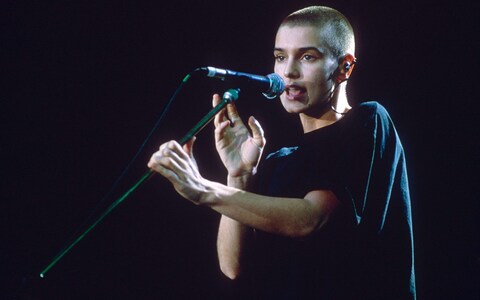
It was hardly a week after Sinéad O’Connor had passed away and I was wandering the bleak airport of Norfolk, VA with a five hour delay. I perused through the book shelves at the trusty Hudson News, and tucked away behind the Sally Rooneys and Becoming Michelle Obamas was Sinéad’s memoir, Rememberings, for $17.99. I had never looked into her much beyond my mother’s occasional fandom; the Boston Irish-Catholics tend to obsess over their distant Irish lineage, desperate for an ounce of unique and marginalized identity.
Nonetheless, I scooped up the paperback and was soon introduced to the martyrdom of a delicate woman capable of mighty artistry who shook the world with both her spoken and sung words. Sinéad O’Connor sang her way into fame and sacrificed that hard-earned platform to give a voice to those who were silenced. To say her public rejection and eventual death was a tragedy is an understatement beyond words. Sinéad is owed so much that we were never able to give her, but we can start somewhere, by sharing her story.
Born in 1966, Sinéad grew up around the Troubles in a deeply catholic household just outside Dublin; the only photo hanging in her mother’s bedroom was a picture of the pope. An imperfect catholic, Sinéad’s mother taught her to steal from the collection baskets at mass. Her parents divorced when she was young, and she suffered years of physical and emotional abuse at the hand of her mother. “Best day of my life was the first day I left Ireland,” Sinéad remarks in Rememberings. “And any other day I left Ireland was the next best.”

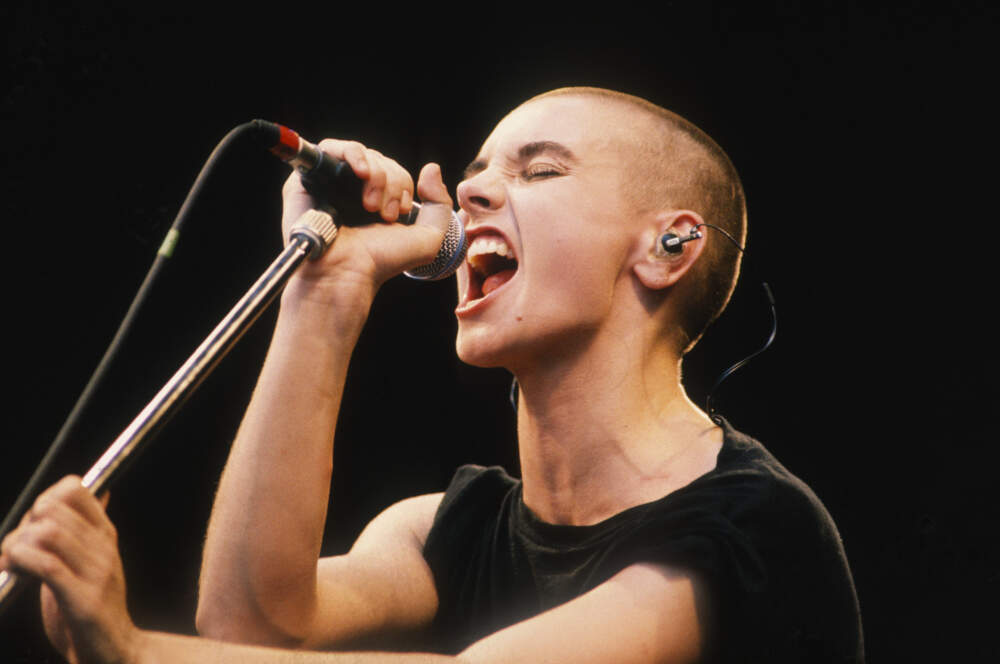
With a voice so poignant and lush, and an aura so magnetic, the success of Sinéad O’Connor was inevitable; her career took off upon her relocation to London and release of her debut record, The Lion and the Cobra, in 1987. Her label told her to grow her hair long, so she shaved it all off, and their attempts to feminize her only pushed her further into the anti-pop star. An alternative icon, Sinéad’s lifelong shaved head represented everything she wasn’t–a product of her industry–and everything she was–just, Sinéad.
Sinéad was put on this earth to do plenty–to sing, to shout, to stand-up, and most dearly, to be a mother. When Sinéad became pregnant with her first child in 1986, she was over the moon. She raved to Nigel, her label’s executive who signed her, and he advised her to see the label’s doctor. When she did, the doctor said that Nigel had already called him, and that she owed it to the label to not have the baby, considering all that they had invested in her. The misogynistic manipulation failed, and Sinéad’s first son, Jake, was born nine months later.
Sinéad brought four children into this world with four different men. She describes her relationships with the fathers of her children in a matter-of-fact manner. They were entangled in either love or lust, they got pregnant, she had the child, they went their separate ways… nothing more to it. John Reynolds, her music producer and father of her first son, is the only exception; “A beautiful dance through life we have had together,” she’s said. “And still have. And will always have.”
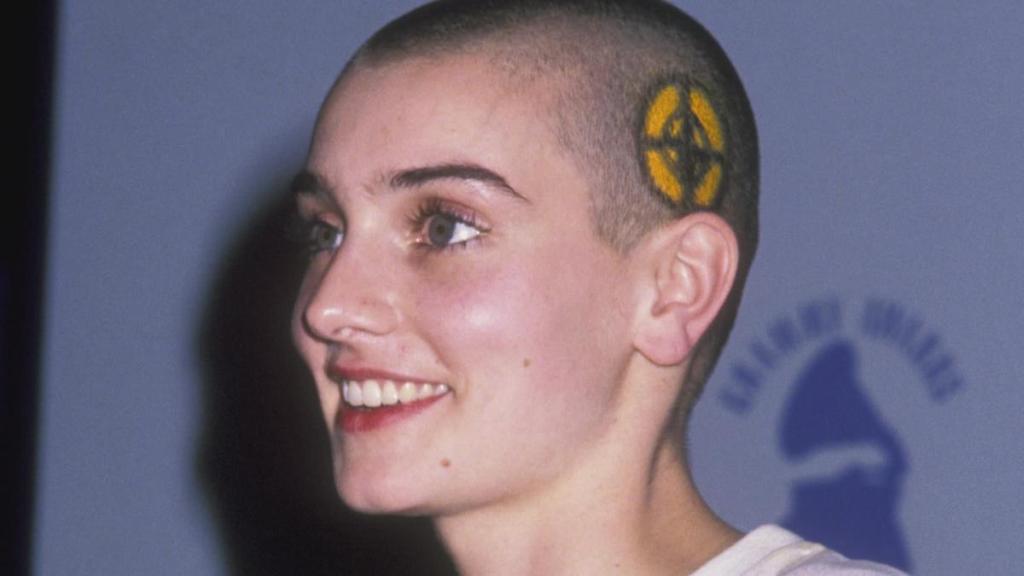
In 1989, the Grammys introduced their first rap category, Best Rap Performance, but excluded it from the televised portion and gave the award off-air. In protest of these racist practices, 22-year-old Sinéad painted the Public Enemy logo on her scalp in solidarity. She flaunted it on the Grammys stage as she sang “Mandinka” for her first major network performance. While most musicians would use this opportunity to sell their product, Sinéad never gave a fuck about that. She only ever gave a fuck about doing what was right.
I Do Not Want What I Haven’t Got was released in 1990, giving us the everlasting “Nothing Compares 2 U,” and an iconic music video to follow; the lone Sinéad in a black turtleneck. She sheds a tear after singing, “All the flowers that you planted mama / In the backyard / All died when you went away.” In Rememberings, Sinéad explains that this wasn’t planned, but a natural reaction caught on camera when thinking of her mother.
Now, what most people don’t know is that “Nothing Compares 2 U” is actually a cover of a Prince song that never gained much traction–Sinéad really brought that one to life. Her relationship with Prince was mostly transactional until one evening shortly after she finished her I Do Not Want What I Haven’t Got tour, Prince sent a limousine to pick her up at her Los Angeles rental, and a wildly unexpected interaction ensued.
When the limousine dropped her off at Prince’s door she rang the doorbell… and no response. When she turned around, the limousine was gone. She rang the doorbell a second time and Prince’s brother Duane opened the door in silence, gesturing for her to come inside. The house was very dark, windows covered in tinfoil.
Sinéad had felt threatened from the moment that Prince met her in the kitchen; he slammed a glass in front of her, insisted that they have a pillow fight, and pressured her to try his soup (???). When Sinéad asked to call a cab, Prince threw a tantrum, and when she tried to leave on foot, he snatched her by the elbow and insisted he drive her home himself. At this, Sinéad made a run for it through the woods. When she finally made it to the highway, Prince drove alongside her, pulled over, and chased her around the car. He threatened to beat her while she spat at him. Eventually, he got back in his car and fled when Sinéad rang the doorbell of a nearby house. She walked to a phone booth, rang her friend, and she never saw Prince again.
On October 3, 1992, right after the release of Am I Not Your Girl?, Sinéad walked onto the Saturday Night Live stage in a delicate white dress that once belonged to Sade. In her hands she held a picture of the pope, the same one that once hung on her mother’s wall. When Sinéad’s mother died in a car crash in 1985, she pocketed the picture while cleaning out her bedroom, certain that she’d destroy it someday. “It represented lies and liars and abuse,” she writes in Rememberings. “The type of people who kept these things were devils like my mother.”
That evening on SNL, Sinéad sang an a capella version of Bob Marley’s “War” and held the picture up to the camera when she landed on the final lyric, “evil.” She nonchalantly ripped it up, said “fight the real enemy,” and threw the pieces to the ground in protest of the catholic church’s child abuse atrocities. She knew she had an audience, and that she might not have them forever, and that she had to speak while they were listening.
The following week, Joe Peschi hosted SNL, and in his opening monologue he showed the camera the same picture of the pope, now pieced back together. He then threatened Sinéad, claiming that if SNL was his show, he would have smacked her and grabbed her by the eyebrows. The crowd roars in laughter, and the culture of misogyny lives on. Sinéad is made into a joke, none of her protest is engaged with, all while the symbolic destruction of her childhood abuse is physically put back together and broadcasted to the world.
To Sinéad, Bob Dylan was a close second to God himself. She absolutely adored him; he planted the musical seed in her when she was just a young girl, and he remained her greatest influence throughout her career.
Just two weeks after her SNL protest, in one of the most heroic performances in music history, Sinéad once again belted the lyrics to Bob Marley’s “War,” but this time in front of Mr. Bob Dylan himself at his 30th anniversary tribute concert. She had initially planned to cover a Dylan song, but was met with an audience so loud, half-booing and half-cheering, she was unable to perform the whispered tune. She stands there and takes it, gazing over the battling crowd with her head held high, defiance written all over her face. And it is in this moment that Sinéad is finally set free.

She looks back on this era not as the derailing of her career (no more hits or gold records after this), but rather what set her back on track; she was never meant to fit the pop-star mold, she was meant to be her loud, angry, and imperfect self. She continued to create wonderful music–Universal Mother in 1994 and Faith and Courage in 2000–for her fans, and raised her children out of the public eye. And nine years later when the Catholic Church finally acknowledged the decades of abuse, no apologies were given to Sinéad.
As a survivor of child abuse, Sinéad battled mental health obstacles up until her death on July 26, 2023. In 2016, she was exploited by Dr. Phil who promised that he’d “fix” her, but only made matters worse with an insincere televised therapy session and a flawed treatment program. Sinéad’s son Shane took his own life in January of 2022, and dear Sinéad passed away a year and a half later. The cause of death has not been confirmed, but it is presumed a suicide.
With roaring courage and a heart so pure, Sinéad O’Connor fought like hell. A heroine unto herself, she used her privilege to sound the alarm on the darkest parts of society that nobody wanted to acknowledge. Allyson McCabe, journalist and Sinéad expert, discusses how Sinéad was never meant to be an entertainer, because artists are not entertainers, entertainers are entertainers. A true artist is there to make you think, and Sinéad does exactly that. And in that way, Sinéad O’Connor never failed.
Rest in power, dear Sinéad.
 The Peeling